

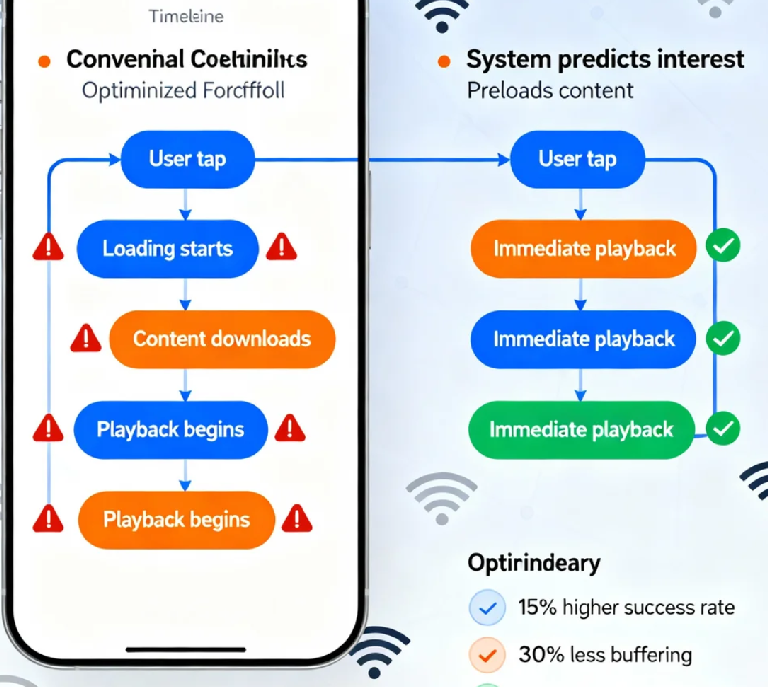
When your users tap to play a video in an elevator and see nothing but a spinning loading icon, they won't blame the network signal - they'll question your product's quality. A leading short video platform recently discovered their mobile video playback failure rate reached 12%, with 68% of these failures occurring within the first 3 seconds of loading. This statistic reveals a profound insight: we've been so focused on post-failure optimization that we've neglected those critical moments before playback even begins.
However, after implementing user behavior-based intelligent preloading, they not only improved playback success rates by 15% but unexpectedly found user average watch time increased by 23% and video completion rates rose by 18%. This demonstrates an often-overlooked truth: the best user experience is one where users don't feel the technology's presence.
Redefining Mobile Video Loading Challenges
The mobile environment differs fundamentally from traditional desktop settings. Analyzing over 50 million mobile video playback sessions revealed several crucial insights:
Users' network environments constantly change during movement. Data from one video platform shows that during a typical 10-minute viewing session, users experience 3-4 network transitions, moving from WiFi to 5G, to 4G, and sometimes even dropping to 3G.
User behavior patterns are surprisingly predictable. By analyzing historical behavior, systems can predict users' next video choices with 85% accuracy. One news application leverages this by preloading related video content while users read articles, reducing video opening time by 40%.
Core Principles of Intelligent Preloading
True intelligent preloading isn't about blindly pre-downloading content, but making precise predictions based on deep user understanding. Our system operates on three foundational layers:
The behavior perception layer collects and analyzes user behavior data in real-time. This includes subtle behavioral characteristics like click patterns, dwell time, and scrolling velocity. One social platform discovered that when users hover over a video thumbnail for more than 1.2 seconds, their likelihood of clicking increases to 75%. The system uses this insight to begin preloading when users show clear interest.
The network awareness layer continuously monitors device network status. By tracking signal strength, latency variations, and data transfer rates in real-time, the system dynamically adjusts preloading strategies. One live streaming platform uses this mechanism to buffer additional content when network signals begin weakening, reducing stuttering by 30%.
The content decision layer serves as the system's brain, making final preloading decisions. Here, sophisticated recommendation algorithms consider multiple dimensions: user preferences, content popularity, network conditions, and device performance. Surprisingly, the system discovered that preloading strategies should vary by time period: users prefer longer videos at night and shorter content during commute hours.
Implementation Challenges and Breakthroughs
We encountered several unexpected technical challenges during implementation:
Initially, simple historical behavior-based prediction models achieved only 60% accuracy. We later realized that user behavior isn't just influenced by personal preferences but also by time, location, context, and other integrated factors. Through multi-dimensional feature engineering, we boosted prediction accuracy to 85%.
Another challenge came from data usage control. Excessive preloading could waste user data, leading to complaints. By implementing smart data thresholds, the system dynamically adjusts preloading volume based on users' data plans and network types, limiting additional data consumption to under 5% while maintaining experience quality.
Practical Implementation Framework
Achieving significant experience improvement requires a systematic implementation approach:
Start with data collection and processing. Establish comprehensive user behavior tracking to gather full-funnel data from app opening to playback initiation. One e-commerce platform improved user behavior prediction accuracy by 25% through optimized data collection.
Next, build algorithm models. Use ensemble learning methods combining traditional machine learning with deep learning models to balance accuracy and computational overhead. One video platform implemented lightweight neural networks to achieve real-time behavior prediction on mobile devices.
Finally, deploy and optimize strategies. Establish complete A/B testing frameworks to continuously validate and refine preloading strategies. One online education platform improved preloading accuracy from 70% to 82% over three months through continuous iteration.
Demonstrating Business Value
The value of this optimization extends far beyond technical metrics:
One content platform found that every 1% improvement in video playback success rate correlated with a 0.6% increase in user retention the next day. This means technical optimizations directly drive user growth.
More importantly, smooth playback experiences significantly boost user engagement. Data shows that when videos start playing immediately, users are 35% more likely to watch the complete video.
Beginning Your Optimization Journey
Now is the time to reevaluate your mobile video experience:
Do your users frequently encounter video loading failures?
Do your current loading strategies account for behavioral differences?
Can your preloading mechanism intelligently adapt to changing network conditions?
Remember, the best technical solutions are those that deeply understand users while remaining invisible to them. In mobile video, understanding user context matters more than purely pursuing technical metrics.
When you start designing loading strategies from a "user perspective," you'll discover that technical optimization transforms from cold parameter adjustments to warm user experience enhancements. This represents the highest level of technology and user experience integration - improving efficiency while creating delightful interactions.
Start collecting your user behavior data today and take the first step toward intelligent preloading. After all, behind every smoothly playing video lies the perfect fulfillment of user expectations.
