

Going Global: Architecting Server Deployment, SSL Strategy & CDN Mesh for International Expansion
It’s 3 AM in the NOC. The Head of Engineering for a scaling SaaS company stares at a performance dashboard splashed with red. Users in São Paulo are experiencing 4.2-second page loads. In Berlin, payment failures are 20% higher than the global average. The API latency graph looks like a jagged mountain range stretching from Singapore to San Francisco. The architecture that powered their domestic success—a monolithic application on cloud servers in Virginia, a single CDN, a standard SSL certificate—is now actively hindering their global ambitions.
This is the moment of truth for any business expanding beyond its home continent. Going global isn't about deploying your existing tech stack in new data centers. It’s a fundamental architectural metamorphosis. You must evolve from a centralized, uniform system to a distributed, adaptive organism that respects the harsh realities of physics, fragmented networks, and divergent local expectations. Your server placement, SSL trust, and content delivery can no longer be an afterthought; they become your primary strategic tools for winning in each new market.
The Unforgiving Physics of Distance & The Network Reality Check
Let's start with an inconvenient truth: the speed of light is too slow for your business plans. Data traveling through fiber optics moves at roughly two-thirds of light speed. The theoretical minimum latency from Frankfurt to Sydney is about 160 milliseconds. Reality, with its router hops, carrier handoffs, and peering disputes, often doubles or triples that figure.
But the real shocker isn't the latency; it's the asymmetry of the global internet. The path your traffic takes from your Virginia server to a user in Mumbai can be radically different—and slower—than the return path. Many networks are optimized for North American or European traffic flows, leaving regions like Southeast Asia or South America on suboptimal, congested paths. Relying on a single global endpoint means you're forcing a significant portion of your users onto the digital equivalent of a scenic, pothole-ridden backroad.
The business impact is not linear; it's exponential. A 2017 study by Akamai found that a 100-millisecond delay in website load time can hurt conversion rates by up to 7%. For a global business, this means your conversion rate is not a single number but a map of inequality, inherently penalizing users based on their longitude and latitude. You're not just delivering a slow experience; you're systematically offering an inferior product to entire continents.
Server Strategy: From Monolithic Hub to Distributed "Cell" Architecture
The old paradigm—a central application cluster serving the world, fronted by a CDN for static assets—is broken for global scale. The new model is the Distributed Cell Architecture.
Think of your global service not as one massive application, but as a collection of semi-autonomous "cells." Each cell is a self-contained deployment in a strategic geographic region (e.g., EU-West, APAC-Southeast, SA-Brazil), containing its own application servers and a regional database replica. It handles most user requests locally, providing sub-50ms latency for the majority of interactions.
Here’s the counterintuitive part: this doesn't necessarily increase complexity—it contains it. A failure in your Tokyo cell doesn't take down your service in Toronto. A schema change for the Brazilian market can be deployed without coordinating a global lockdown. Local compliance requirements (like data residency laws) are naturally satisfied.
The magic—and the complexity—lies in the data synchronization mesh. You must categorise your data:
Global Truth (User Identity, Core Config): Synchronized in near-real-time across cells using a robust tool like AWS DynamoDB Global Tables or a carefully managed Cassandra cluster.
Regional Context (Local Inventory, Pricing): Lives and dies within the cell. It never needs to leave its region.
Ephemeral Session Data: Handled by a globally distributed, low-latency data store like Redis with active-active replication.
This architecture accepts that not all data needs to be globally consistent at all times. It trades the complexity of massive, monolithic databases for the complexity of intelligent data flow—a trade-off that becomes essential for survival at global scale.
SSL/TLS: Navigating the Labyrinth of Local Trust
You assume an SSL certificate from a major global Certificate Authority (CA) is a universal passport of trust. It is not. Trust is local.
In countries like China and Russia, government-approved or locally dominant CAs have higher root certificate penetration in domestically produced browsers and operating systems. Your site secured by a top-tier Western CA might still trigger security warnings for a segment of users. In Japan and South Korea, certain financial and government sectors maintain their own strict trust lists.
The solution is a Tiered Certificate Strategy:
Primary Global Certificate: An OV or EV certificate from a top-tier CA (DigiCert, Sectigo) for your primary
.comdomain, serving most of the world.Strategic Local Certificates: For your country-code top-level domains (
.co.jp,.de) or critical regional subdomains, procure certificates from a CA that is particularly trusted in that jurisdiction. Tools like SSL Labs' Server Test can help you understand the trust chain from different locations.Automated Certificate Management: Using a platform like HashiCorp Vault or LetsEncrypt with the DNS challenge, automate the issuance and renewal of potentially dozens of certificates. Manual management is a recipe for a catastrophic outage.
Furthermore, TLS protocol and cipher suite support varies globally. Outdated corporate firewalls in certain regions may choke on TLS 1.3 or specific modern ciphers. While you shouldn't downgrade your main configuration, having intelligent edge logic (at your CDN) that can gracefully negotiate the best possible secure connection for each client is key.
The CDN Mesh: Your Intelligent, Redundant Traffic Cortex
Putting all your global traffic eggs in one CDN basket is the single point of failure you didn't know you had. A regional outage, a peering dispute, or a configuration error with that vendor can blackhole an entire continent.
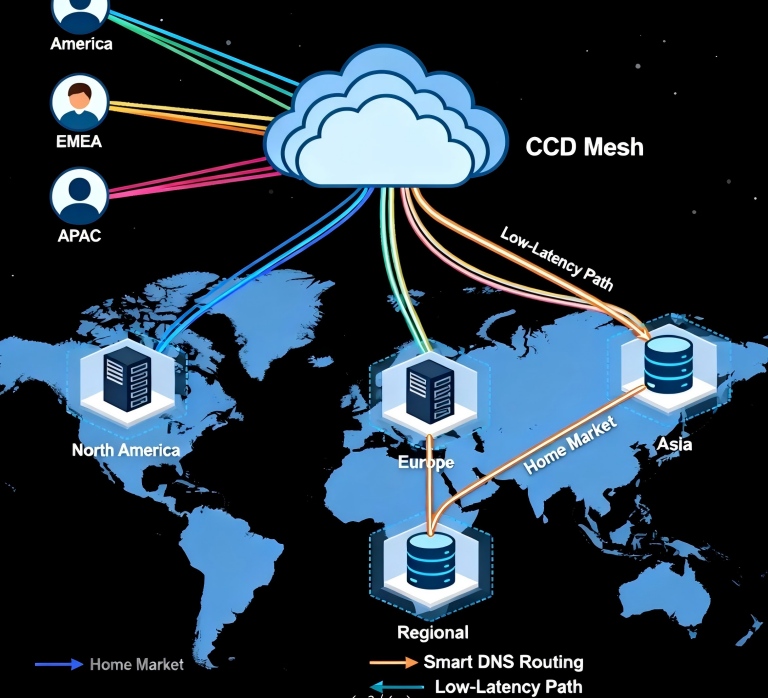
The modern solution is the Intelligent CDN Mesh. This is not merely "multi-CDN" (running two vendors side-by-side). It is a dynamic routing layer that treats multiple CDNs as a pool of resources.
How it works:
Real-Time Performance Monitoring: A global network of probes (using Catchpoint or ThousandEyes) continuously measures latency, throughput, and error rates from hundreds of locations to each of your CDN providers.
Smart DNS/Routing Layer: A provider like NS1 (with its Filter Chain technology) or a cloud-based Global Server Load Balancer ingests this performance data. When a user in Madrid looks up your domain, the DNS doesn't return a static CDN IP. It executes logic: *"Right now, for this user's ISP, CDN-A is 80ms faster in Madrid than CDN-B. Route to CDN-A."*
Unified Cache Invalidation: The biggest challenge of a CDN mesh is cache consistency. Solutions involve using a shared object storage (like Amazon S3) as the origin for static assets, or implementing a custom purge API that broadcasts invalidation to all CDN networks simultaneously.
The result? You're no longer at the mercy of any one provider's "bad day." You get the best performance available globally at any given moment, and you gain immense leverage in cost negotiations.
The Reverse Challenge: Don't Forget the Home Market
In the fervor to optimize for new international users, companies often architect a "reverse performance cliff" for their original home market. Routing all traffic—including domestic—through a new global load balancer or distant origin can add needless latency.
The answer is bi-directional optimization. Your architecture must make intelligent, geography-aware decisions:
A user in Paris hits your European cell via the EU-optimized CDN mesh.
A user in New York accesses the North American cell.
Crucially: A user in your home country should have a dedicated, low-latency path to their "home cell," potentially bypassing some of the global routing logic. This may involve maintaining a simplified, high-performance access path for your core market.
Your 90-Day Global Architecture Roadmap
This isn't a theoretical exercise. Here's how to start:
Month 1: Discovery & Cell Design
Map Your Users: Use analytics to identify your top 3 international growth regions.
Define Your Cells: Design the first two cells (e.g., "Americas" and "EMEA"). Decide which data is global, regional, and ephemeral.
Benchmark Everything: Use WebPageTest from global locations to document your current baseline performance.
Month 2: Build & Deploy First Cells
Deploy Cell Infrastructure: Use Infrastructure-as-Code (Terraform, Pulumi) to replicate your application stack in a second region.
Implement Data Sync: Set up the replication for your "Global Truth" data category.
Procure Local SSL: Acquire certificates for your new regional endpoints.
Month 3: Implement Intelligent Routing & Mesh
Onboard a Second CDN: Start with a simple failover configuration.
Deploy Smart DNS: Implement a DNS-based traffic director to route users to the nearest cell.
Establish Monitoring: Build a global real-user monitoring (RUM) dashboard. Tools like Pingdom or DataDog Synthetics are essential.
Going global successfully isn't measured by the number of countries you appear in. It's measured by your ability to disappear as a foreign entity. When the user in Jakarta feels like they're using a local service—with local speed, local trust indicators, and local reliability—you've won.
Your architecture ceases to be a collection of servers and certificates. It becomes the silent, intelligent ambassador of your brand's promise in every market you enter. It acknowledges that the world is not a uniform digital plane, but a complex, varied landscape. The ultimate competitive advantage in global business is no longer just your product's features, but your infrastructure's profound respect for the distance, both physical and cultural, that it must bridge. Start building not just for scale, but for intelligent, graceful localization. The world is waiting—but it won't wait long.
