

Beyond Basic Setup: The Strategic CDN Configuration That Boosts Dedicated Server Performance & Slashes Costs
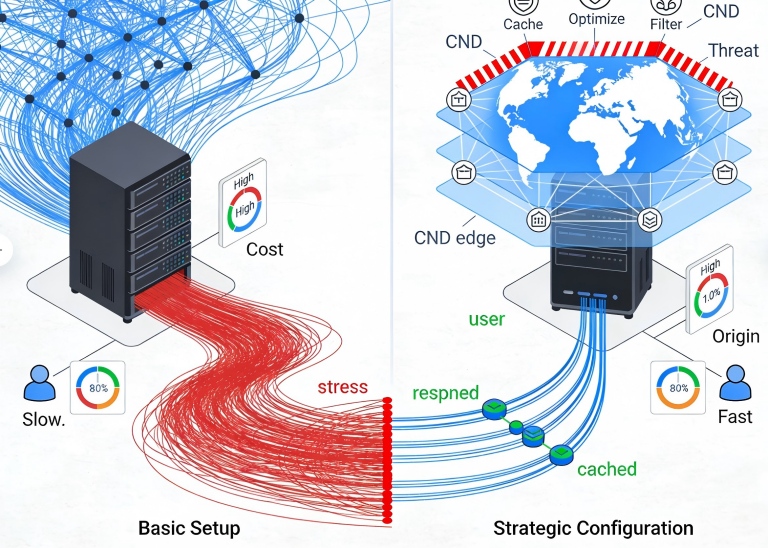
Let’s be brutally honest for a moment. You invested in a powerful dedicated server—significant capital, high-end CPUs, ample RAM, NVMe storage. You’ve tuned the database, optimized your code, and yet, something’s off. Your analytics show users in regions farther from your data center experience inconsistent performance. Your bandwidth bills have a mysterious, stubborn bulk that doesn’t quite match your traffic logs. You added a Content Delivery Network (CDN) because “it’s what you do,” but the transformation you expected—the effortless global speed, the dramatic cost drop—feels muted.
Here’s the uncomfortable truth most providers won’t lead with: Simply plugging a CDN into your dedicated server is like attaching a jet engine to a bicycle with duct tape. The potential is there, but without strategic integration, you’re missing 80% of the value, wasting money, and likely creating new bottlenecks.
The common narrative sells the CDN as a magic black box for speed. The real story, the one that unlocks 40% performance gains and halves bandwidth costs, is about rearchitecting your delivery strategy from the ground up. It’s about shifting the CDN from a passive cache to an active, intelligent edge partner for your powerful origin server.
The Dedicated Server Dilemma: Power Versus Geography
Your dedicated server is a fortress. It offers control, raw power, and consistent I/O—qualities cloud VPS dreams of. But it suffers from a fundamental, physics-bound constraint: it sits in one place. Every millisecond of latency for a user in Sao Paulo, Berlin, or Sydney visiting your server in Ashburn is a tax on their patience and your conversion rate.
The bigger, often hidden cost is in the 95th Percentile Billing model common with premium bandwidth. Your bill isn’t based on average use, but on your peak 5% of traffic. That one-hour flash sale or midday traffic spike sets your entire month’s bandwidth rate. You’re paying a “peak tax” for infrastructure that sits underutilized most of the time.
This is the core irony: you pay for a consistently powerful machine, yet you’re billed for inconsistently delivered data. The traditional solution—throwing more bandwidth or a bigger server at the problem—only deepens the cost trap.
The Three-Tiered Misconfiguration: Why Basic CDN Setup Fails
Most setups stop at "point your DNS to the CDN." This superficial layer leaves three critical misconfigurations on the table:
The Static-Only Mindset: Only images, CSS, and JS are cached. Dynamic content—product listings, user sessions, API calls—makes a full, expensive round-trip to your origin every single time, nullifying the CDN’s latency benefit for the most interactive parts of your site.
The "Set-and-Forget" TTL Trap: Using blanket Time-To-Live values (like 24 hours for all assets) is a disaster. It means stale content for users or unnecessary origin load when you push updates.
The Ignored Security Handoff: The CDN is treated as a dumb pipe, not the first line of defense. Malicious bots, DDoS probes, and vulnerability scans hit your origin server directly, consuming the precious CPU and IOPS you paid for, instead of being filtered at the edge for pennies on the dollar.
This basic setup utilizes maybe 20-30% of the CDN’s capability. The remaining 70% is where the strategy—and the savings—live.
The Strategic Shift: Transforming Your CDN into an "Edge Compute Partner"
The leap forward requires a mindset shift: stop seeing your CDN as a separate caching service and start viewing it as the global, intelligent front-end to your dedicated server back-end.
Layer 1: Intelligent Caching & Origin Shield
This is about surgical precision. Instead of caching only static files, implement logic to cache what you can, where you can.
Dynamic Content Caching: Use CDN rules to cache API responses, product category pages, and blog posts for short, intelligent durations (e.g., 1-10 minutes). Combine this with cache purging APIs for instant updates. This can reduce origin load by 60-80% for content-heavy sites.
Origin Shield Configuration: Don’t let all your global CDN nodes hit your origin directly. Designate one or two “shield” nodes. All other nodes fetch from the shield, which then fetches from your origin. This collapses potentially thousands of concurrent requests during a viral traffic spike into a single, cache-refreshing request to your server. It’s a force multiplier for your server’s ability to handle surges.
Layer 2: Protocol Optimization & Asset Revolution at the Edge
Your server speaks HTTP/1.1 or HTTP/2. A strategic CDN negotiates the best possible protocol with the end-user.
Automatic HTTP/3 (QUIC) Delivery: For the 80% of modern browsers that support it, the CDN delivers content over QUIC, which eliminates TCP handshake delays and excels on unstable mobile networks, directly improving real-user metrics.
On-the-Fly Image Optimization: The CDN edge detects the user’s device and browser. A desktop Chrome gets a WebP image; an older Safari gets a JPEG; a mobile device on a slow connection gets a heavily optimized, smaller AVIF. You store one high-quality master image on your server, and the CDN delivers dozens of optimized variants globally, slashing bandwidth consumption by 40-70% on image-heavy pages without lifting a finger.
Layer 3: Cost Migration & Security Offload
This is the most impactful financial strategy. Migrate cost from your expensive dedicated server bill to your far more efficient CDN bill.
Bot Mitigation & Security Rules: Configure the CDN’s Web Application Firewall (WAF) to block common exploits, rate-limit abusive IPs, and challenge suspicious bots before they reach your origin. This isn’t just security; it’s cost control. You stop paying for bandwidth and CPU cycles to serve attackers and scrapers.
The Bandwidth Arbitrage Play: Premium data center bandwidth is costly. CDN providers, due to their immense scale and peering agreements, have drastically cheaper bandwidth costs per gigabyte. By ensuring 90%+ of your content is served from the CDN cache (the edge), you’re shifting the bulk of your data transfer from your expensive server line item to your more affordable CDN plan. This is the primary engine of the “bandwidth cost halved” outcome.
The Four-Step Action Plan: From Theory to Tangible Metrics
Audit & Baseline: Use your CDN’s analytics (or install a logging tool) for one week. Answer: What is your cache-hit ratio? What percentage of requests are going to origin? What are your top file types by bandwidth? Identify the low-hanging fruit.
Implement Tiered Caching Rules: Create three caching rule sets in your CDN dashboard:
Aggressive: Static assets (CSS, JS, fonts, immutable images). Cache for 1 year, with versioning in filenames.
Strategic: Semi-dynamic content (product listings, blog archives). Cache for 1-10 minutes, implement purge-on-update.
Bypass: Truly dynamic content (shopping cart, user profile). Never cache, but ensure the path is protected by rate limiting.
Enable Advanced Features: Turn on “Image Optimization,” “HTTP/3,” and “Origin Shield” in your CDN settings. Configure basic WAF rules to block known bad bots and common attack patterns.
Monitor & Iterate: After one month, analyze again. Your cache-hit ratio should have jumped (aim for >90%). Your origin bandwidth should have plummeted. Your server’s CPU/RAM graphs should show less dramatic spikes. Use these metrics to justify further optimization.
The goal isn’t just a faster website or a slightly lower bill. The goal is architectural clarity and financial predictability. You stop being a victim of geography and traffic spikes.
Your powerful dedicated server transitions into its ideal role: a secure, stable, and potent “brain” for generating and processing core data, unburdened by the chaos of global delivery. The strategic CDN becomes its “nervous system,” efficiently managing global interactions, filtering threats, and optimizing every byte.
You move from a state of constant reaction—scaling up to meet peaks, fighting unexpected bills—to a state of calm, proactive control. Your server’s power is finally fully expressed to the user, no matter where they are, and you’re only paying for what you truly need. That’s not just an optimization; it’s the sign of a mature, high-performance infrastructure.
