

End-to-End Observability Implementation: Unified Monitoring Platform Practice from Logs, Metrics to Distributed Tracing
Let's be honest. If you've ever been woken up at 3 a.m. by a screeching alert, only to spend the next frantic hour clicking between fifteen different dashboards, log systems, and tracing tools trying to piece together what is actually broken, you know the problem. The most expensive failures in modern systems don't live in your code. They live in the blind spots between your monitoring tools.
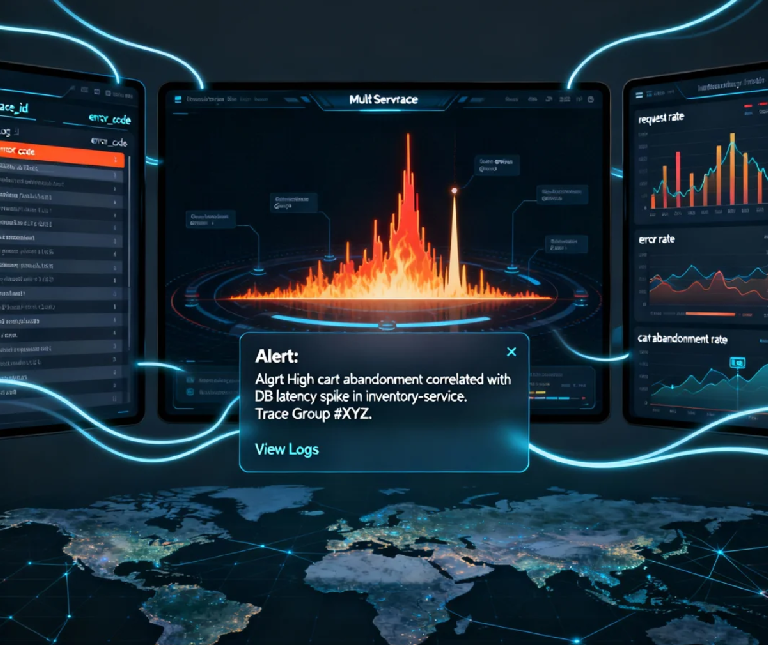
I recall a major e-commerce platform during a sales event. Their checkout was failing intermittently. Their Application Performance Monitoring (APM) dashboard was green. Server metrics were stable. Logs showed no ERROR entries. Yet, carts were being abandoned. The breakthrough came not from any single tool, but from a correlation: a latency spike in a specific database span in the distributed trace, plotted against the real-time business metric of cart abandonment rate. In isolation, each system reported "normal." Only when connected did they tell the true story: a downstream lock contention under specific load. This is the "light under the lamppost" fallacy of traditional monitoring.
We collect oceans of data but remain blind to what's happening inside our systems. Observability is the discipline of lighting up those dark corners. It's not a replacement for monitoring; it's its evolution. Monitoring answers pre-defined questions: "Is the CPU over 80%?" Observability enables you to ask any question: "Why did checkout conversion for premium users in Europe drop by 18% between 2 and 3 p.m.?"
Part 1: From Siloed Data to Connected Insight – A Paradigm Shift
A hard truth: adding more dashboards and alert rules does not make you understand your system better. Traditional monitoring is excellent for "known unknowns." Observability is designed for the "unknown unknowns." It rests on the deep integration of three pillars, not their parallel existence.
Metrics: The Pulse and Vital Signs
Beyond Infrastructure: It's not enough to track CPU and memory. The modern approach captures Golden Signals (Latency, Traffic, Errors, Saturation) and, crucially, Business Metrics ("orders per second," "average cart value").
The Unexpected Insight: A social media company found its API error rate flat. However, when correlated with the business metric "new user sign-up source," they discovered users from a specific partner platform were failing at a high rate due to a deprecated API version. Metrics gain power from context.
Logs: The Structured Narrative
Beyond
printfDebugging: The era of unstructured text logs as the primary source is over. Structured logging (e.g., JSON) is non-negotiable. Every log event should be a machine-readable packet of context:user_id,transaction_id,session_id.Managing the Chaos: Volume is the enemy. The key is intelligent sampling (sample all errors, 1% of debug logs) and log-derived metrics (aggregating frequent log patterns into real-time metrics). This balances cost with informational density.
Distributed Tracing: The X-Ray Image
The Connective Tissue: This is the breakthrough. A single user request—from the edge through APIs, microservices, databases, and caches—is recorded as a Trace, composed of timed Spans representing each operation.
The Power of Aggregation: The greatest value of tracing is often not debugging a single slow request. It's in the aggregate view. Flame graphs and service dependency maps generated from millions of traces show you, unequivocally: Is Service B the latency bottleneck? Is the call to Cache C failing 15% of the time? This architectural transparency is uniquely powerful.
Part 2: The Implementation Path – Building Your "Observability Brain"
Unification doesn't mean dumping three types of data into one database. It means establishing semantic links between them. This is a three-layer journey.
Layer 1: Unified Data Collection & Instrumentation
This is the foundation. You need a consistent approach. The industry is converging on OpenTelemetry as the standard. It provides a vendor-neutral, unified set of APIs, SDKs, and tools to generate, collect, and export traces, metrics, and logs. Instrument your applications once, and your data is structured for correlation from the start. Agents collect this data, enriching it with consistent tags/labels (service=checkout, region=eu-west-1, pod_id=xyz).
Layer 2: The Correlation Engine (The Core)
This is where insight is born. Your platform must be built for Trace Context Propagation.
When an error is logged, the log entry must automatically include the current
trace_id.When the P99 latency metric for an API spikes, you should be able to drill down directly to the list of specific, slow traces causing it.
When investigating a problematic trace, you should have a one-click option to see all logs emitted by every service involved in that exact request journey.
This creates a virtuous cycle: Metrics tell you what is anomalous, Traces show you where in the flow it happened, and Logs explain why.
Layer 3: Unified Consumption & Action
Correlated data needs a unified interface to deliver value.
Unified Querying: Engineers should be able to ask cross-cutting questions: *"Show me all traces and their associated error logs for the 'payment-service' where latency was >2s and the user was in the 'premium' tier in the last hour."*
Intelligent, Context-Rich Alerting: Alerts should transform from "High CPU!" to: *"Alert: Checkout success rate for premium users is degrading. Root cause likely related to database latency spikes in the 'inventory-service' (see correlated trace group), with relevant errors mentioning 'connection pool exhausted'. Primary impact is in the 'us-east-1' region."* The alert becomes a first-tier diagnostic report.
Business Journey Mapping: Link front-end user sessions (via Real User Monitoring) with back-end traces. Follow a single user's click on "Buy Now" through every service call, understanding exactly where their experience succeeded or failed.
Part 3: Beyond Technology – The Business Value and the Cost Paradox
This sounds like a significant investment. It is. But the return is transformative.
Value 1: Drastic Reduction in MTTR (Mean Time to Resolution). The e-commerce scenario moved from a 4-hour war room to a 15-minute diagnosis. When data is connected, engineers stop searching and start solving. Studies suggest teams with mature observability practices can reduce outage resolution times by over 90%.
Value 2: Proactive Performance & Cost Optimization. Traces provide an undeniable map of service dependencies and resource consumption. One company analyzed its traces and found 25% of all service calls were redundant or could be cached, leading to a 15% reduction in cloud compute costs. You can't optimize what you can't see.
Value 3: Aligning Tech with Business Outcomes. Define the "golden path" for a key transaction (e.g., user sign-up → product view → purchase) and monitor its health as a first-class business KPI. You can now answer questions from leadership about user experience with data, not anecdotes.
Here lies the cost paradox: A well-designed, high-signal observability platform often has a lower Total Cost of Ownership (TCO) than a fragmented pile of legacy tools. Why? Because you are trading capital expense (tool licenses, storage) for the most valuable resource: engineering time spent debugging. You're preventing revenue-draining outages and accelerating feature development by making the system understandable.
Conclusion: It Starts as a Tool, But It Grows Into a Culture
Implementing end-to-end observability begins as a technical project—choosing tools, instrumenting code, building pipelines. But its true power is realized only when it becomes part of your engineering culture.
It requires developers to think about observability as they code (What traces, metrics, and structured logs will make this feature debuggable?). It requires SREs and platform engineers to think in terms of connected systems, not isolated components. It shifts the focus from "responding to alerts" to "understanding the system."
So, look at your current landscape. Are there dark corners where your tools don't shine? The next time an incident occurs, will your team be lost in a maze of disjointed tabs, or will they have a unified map to guide them to the root cause?
True observability doesn't give you more noise. It gives you clarity and confidence. It transforms a complex, distributed system from a source of constant anxiety into a comprehensible, manageable engine of value. The journey starts with connecting your first log to your first trace. Begin there. Because in the end, you cannot improve a system you cannot measure, and you cannot truly master a system you cannot observe.
