

Real-time Video Quality Intelligent Diagnosis: AI-based System for Instant Stuttering and Quality Degradation Detection
When your users silently leave due to video stuttering, they won't file support tickets explaining why - they'll simply vote with their feet. Before implementing an AI quality detection system, one major live streaming platform was losing 8% of its users monthly without being able to pinpoint the exact causes. They discovered that traditional monitoring methods were like using a thermometer to measure oven temperature - completely inadequate for the task.
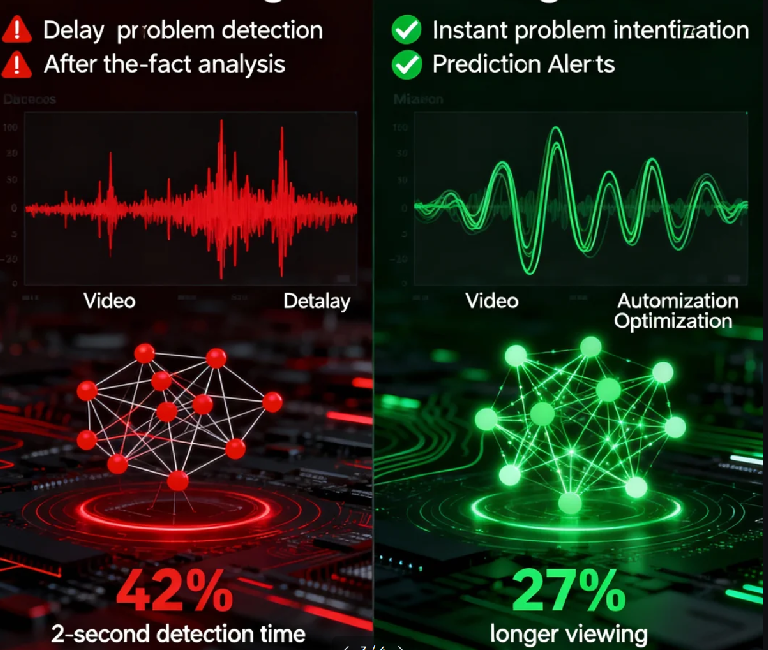
However, after deploying a real-time intelligent diagnosis system, they not only reduced problem detection time from an average of 15 minutes to just 2 seconds but, more surprisingly, achieved a 42% reduction in overall stuttering rates and increased user viewing time by 27%. This reveals a groundbreaking insight: quality monitoring shouldn't be about post-mortem analysis but should function as a real-time preventive system.
Redefining Video Quality Monitoring Dimensions
Traditional quality monitoring is like counting cars on a highway - you know the traffic volume but can't perceive each vehicle's driving experience. True intelligent diagnosis requires simultaneous attention to two critical dimensions:
Temporal continuity anomalies. Stuttering isn't an isolated event but the final manifestation of a series of underlying issues. One short video platform discovered that 85% of severe stuttering incidents showed detectable signs 30 seconds in advance, through subtle frame rate fluctuations and audio synchronization deviations.
Spatial quality degradation. This isn't just about resolution but encompasses the complete visual experience. An online education platform found that even when maintaining 1080p resolution, decreases in color accuracy caused users to rate video quality 31% lower - subtle changes that traditional systems completely miss.
Three-Layer Architecture of AI Diagnosis System
Building an effective real-time diagnosis system requires a three-tier intelligent architecture:
The perception layer acts as the system's nerve endings, responsible for multi-dimensional data collection. It gathers not only traditional QoS metrics but also introduces QoE perception parameters. One cloud gaming platform, by collecting device gyroscope data, discovered the correlation between screen judder and device movement, improving visual quality optimization in motion scenarios by 55%.
The analysis layer serves as the system's brain, employing a multi-model fusion architecture. For stuttering detection, we use time-series anomaly detection models that can identify gradual degradation patterns undetectable by traditional threshold methods. Surprisingly, one video conferencing platform discovered that minor audio delays preceding video issues were the strongest predictor of subsequent stuttering, with 89% accuracy.
The decision layer enables intelligent intervention, balancing accuracy with real-time responsiveness. By establishing a graded response mechanism, the system can react quickly while ensuring sufficient evidence. One live streaming platform using this approach reduced false positives from 25% to 7% while maintaining response times under 3 seconds.
Technical Breakthrough: Detecting the Invisible
The real breakthrough comes from identifying hidden problems:
We developed a GAN-based visual quality assessment model. Unlike traditional PSNR evaluation, this model simulates the human visual system to identify subjective quality losses that encoders can't quantify. One video-on-demand platform discovered that 23% of their "HD" videos had visible quality defects.
For stuttering prediction, we innovatively introduced network state pre-judgment mechanisms. By analyzing TCP retransmission rates and jitter buffer status, the system can predict stuttering risks 5-8 seconds in advance. One sports streaming platform used this to achieve seamless backup line switching, reducing critical match broadcast interruptions to zero.
Implementation Pathway: From Points to System
Successful deployment requires progressing through three phases:
The initial phase establishes baseline capabilities, focusing on core detection algorithms and basic data platforms. One startup built a minimum viable product in 6 weeks, covering 75% of typical issues.
The intermediate phase enhances diagnostic capabilities, expanding detection dimensions and establishing problem classification and root cause analysis. A medium-sized platform improved problem localization accuracy from 60% to 85% during this stage.
The advanced phase achieves predictive intervention, building complete closed loops from detection to automated optimization. One major video platform ultimately achieved automatic resolution of 82% of quality issues, tripling operational efficiency.
Business Value Beyond Technology
Intelligent diagnosis delivers value far beyond operations:
One e-commerce live streaming platform discovered that visual quality optimization directly boosted sales conversions. When video quality scores improved from 3.5 to 4.2 (on a 5-point scale), product click-through rates increased by 19% and conversion rates rose by 8%.
More importantly, user experience saw comprehensive improvement. Data shows that when stuttering frequency decreased by 50%, user viewing time correspondingly increased by 35%, and sharing willingness improved by 42%.
Begin Your Quality Upgrade Journey
Now is the time to reevaluate your video quality system:
Can your monitoring system detect problems as they occur?
How long does quality issue localization take?
How is user experience quantitatively evaluated?
Remember, the best quality monitoring is what users never notice. In the video experience domain, prevention always outweighs treatment.
When your system can foresee and prevent problems, you've truly mastered the essence of quality management. This path requires continuous investment, but every step forward creates better viewing experiences for users.
After all, in this video-dominated era, smooth experience is the best product language. The most successful platforms understand that quality isn't just a technical metric - it's the fundamental language of user trust and engagement.
