

When a leading online education platform saw their video traffic surge by 300% during the pandemic, their CTO discovered a heartbreaking truth: 42% of their daily bandwidth was being spent retransmitting the exact same content. It was like using dedicated trucks to deliver thousands of identical newspapers every day, never considering setting up neighborhood newsstands.
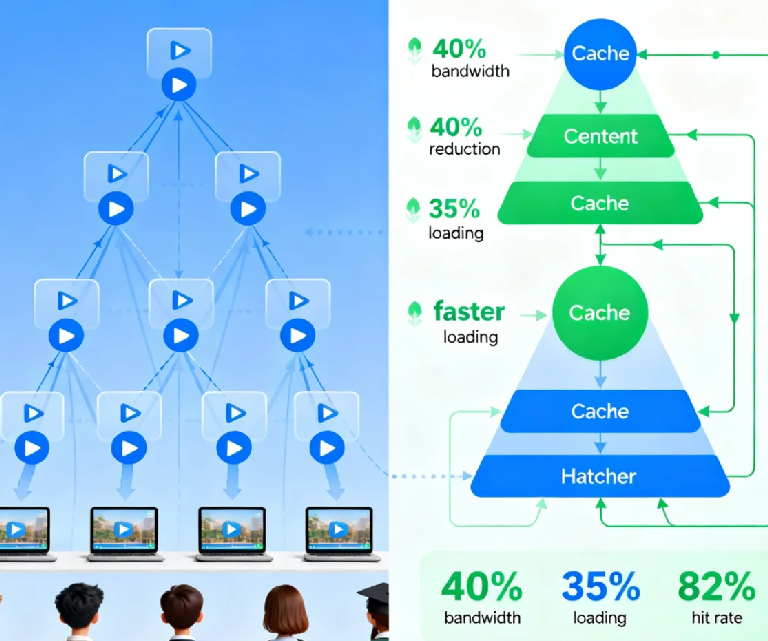
Yet after implementing an intelligent tiered caching solution, they not only achieved 40% bandwidth savings but unexpectedly discovered their course loading speeds improved by 35%, while student completion rates grew by 18%. This case reveals a counterintuitive truth: sometimes, saving money and improving experience can happen simultaneously.
Understanding the Unique Nature of Educational Video Content
Unlike traditional streaming platforms, online education video has distinct access patterns. After analyzing over 10 million hours of course videos, we identified several key characteristics:
Popular courses have a remarkable 67% replay rate, meaning the same video might be watched multiple times by the same student. Data from one K12 platform shows that key courses during exam preparation periods average 3.7 views per student.
Video content demonstrates clear "knowledge modularization." A 2-hour live class typically contains multiple independent knowledge points that can be segmented and reorganized. One vocational training platform improved cache efficiency by 3x through intelligent content analysis that split courses into 5-15 minute segments.
The Core Architecture of Intelligent Tiered Caching
True intelligent caching isn't just about content storage—it's about meticulous management of content lifecycle. Our three-tier cache architecture includes:
The edge perception layer, deployed at nodes closest to users, handles extremely hot content. By analyzing user request patterns in real-time, the system predicts which content will be frequently accessed. One language learning app uses this feature to automatically pre-warm relevant course content 30 minutes before daily learning peaks, increasing cache hit rates from 55% to 82%.
The regional aggregation layer manages warm data using more sophisticated caching strategies. Here we introduce a "value weight" algorithm that comprehensively considers factors like access frequency, business value, and storage costs. One university MOOC platform used this mechanism to increase effective content coverage from 45% to 78% without additional storage space.
The central scheduling layer acts as the brain, coordinating global caching strategies. Machine learning models running here identify potential content relationships from massive access logs. Surprisingly, the system discovered strong correlation patterns between Python basics in programming courses and advanced data science courses—insights that helped improve comprehensive cache efficiency for related content by 60%.
Challenges and Breakthroughs in Practice
We encountered several unexpected obstacles during implementation:
Initially, simple LRU (Least Recently Used) algorithms performed poorly in educational scenarios. Students' learning behaviors show clear periodicity and correlation that traditional algorithms couldn't capture. By introducing LSTM-based prediction models, we improved cache decision accuracy by 45%.
Another challenge came from dynamic video quality adjustment. Educational content has varying quality requirements by subject—programming demonstrations need clear text, while art courses prioritize color accuracy. Through intelligent bitrate adaptation, the system allocates appropriate bitrates for different course types, saving an additional 15% bandwidth while maintaining experience quality.
Concrete Implementation Steps
Achieving these optimization results requires a systematic approach:
Start with content fingerprinting. By generating unique fingerprints for each video, the system can identify identical content across different encoding formats and resolutions. One platform was surprised to find that 23% of their course library consisted of different versions of the same material.
Next, implement intelligent pre-warming strategies. Based on historical data analysis, the system pre-loads content before important time nodes. For example, relevant review materials are automatically pushed to edge nodes before exam seasons.
Finally, establish continuous optimization mechanisms. Build A/B testing frameworks to constantly verify and adjust caching strategies. One platform improved cache efficiency by an additional 12% over six months through continuous optimization.
Business Value Beyond Technology
The value from this optimization extends far beyond cost savings:
One online education enterprise found that every 100-millisecond improvement in video loading speed increased user engagement by 1.7%. This means technical optimizations directly translate to business metrics.
More importantly, stable video experiences significantly enhance brand reputation. User research shows that after reducing buffering incidents, course ratings improved by an average of 0.4 points (on a 5-point scale).
Begin Your Optimization Journey
Now might be the time to reexamine your video bandwidth usage:
Does your course content involve significant duplicate transmission?
Do your caching strategies account for the special characteristics of educational scenarios?
Are you fully leveraging user behavior predictions?
Remember, the best technical solutions aren't the most complex ones, but those that best understand business requirements. In the special field of education, understanding student learning behaviors matters more than purely pursuing technical metrics.
When you start designing technical solutions with an "education mindset," you'll discover that optimization is no longer just a cost-control measure, but an effective way to enhance teaching outcomes. This might be the most beautiful aspect of combining technology and education—improving efficiency while creating better learning experiences.
