

AI-Driven CDN Intelligent Operations: Achieving 95% Fault Prediction Accuracy with Automated Repair Systems
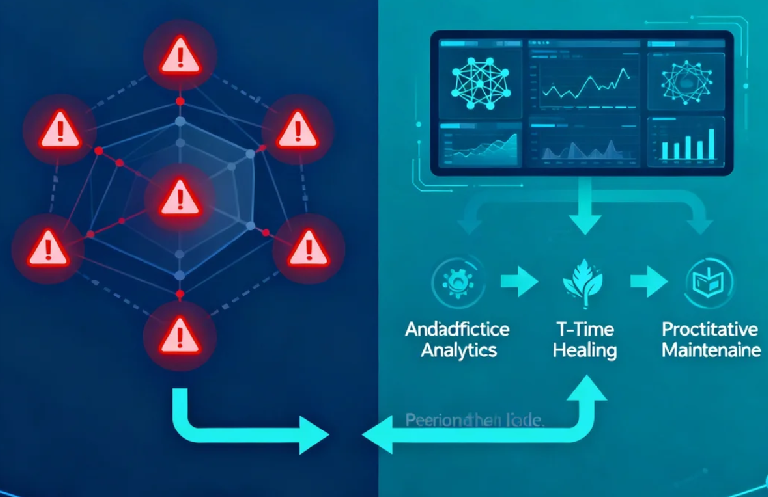
While your operations team is still being woken by emergency alerts in the middle of the night, one major e-commerce platform's AI system has already predicted and automatically repaired 47 potential faults - all without human intervention, while maintaining 99.99% system availability throughout. This isn't a scene from a sci-fi movie, but an ongoing technological revolution that's reshaping how we think about network operations.
Just last week, the operations lead at this e-commerce platform shared a surprising statistic: their AI operations system has achieved 95% accuracy in fault prediction over the past three months, with false positives reduced to just 2%. Even more remarkably, the system's automated repair success rate reached 88%, allowing their human engineers to focus on architectural improvements rather than constantly fighting fires.
Redefining the Boundaries of Operations
Traditional operations models resemble fire departments - always rushing to the scene after the fire has started. AI-driven intelligent operations, however, function more like sophisticated health monitoring systems that can detect abnormal symptoms before conditions manifest. One video streaming platform's experience is particularly telling: their AI system analyzed network traffic patterns and predicted a regional network congestion 30 minutes in advance, automatically implementing traffic rerouting to prevent service disruption.
This represents a fundamental shift in perspective: AI operations aren't about replacing engineers, but about freeing them from repetitive firefighting tasks to focus on more valuable architectural optimization and strategic planning. One cloud provider's experience demonstrates this clearly - after deploying their AI operations system, senior engineers tripled the time they could dedicate to innovation projects.
Three Technical Pillars of Intelligent Operations
Achieving high-accuracy fault prediction and automated repair requires deep integration of three core technologies:
First is multi-dimensional data collection and processing. Intelligent operations systems need to analyze massive datasets in real-time, including performance metrics, log data, network traffic, and hardware status. One financial institution's system processes over 2 million data points per second, using anomaly detection algorithms to identify subtle patterns that would escape human notice.
Second is continuous optimization of machine learning models. Fault prediction isn't a one-time model training exercise, but requires ongoing learning and adaptation. One social platform employs online learning mechanisms that allow models to continuously adjust based on new data, gradually improving prediction accuracy from an initial 75% to the current 95%.
Most crucial is automated decision-making and execution. Predicting faults is only the first step - the real value comes from automatically implementing the correct repair measures. One e-commerce platform has built a knowledge base containing hundreds of repair protocols, enabling the system to intelligently select optimal solutions based on fault type and impact scope.
Implementation Pathway: Progressive Evolution from Assistance to Autonomy
Successful deployment of AI operations systems requires a phased approach, typically progressing through three stages:
The first stage is assisted diagnosis. Here, the AI system serves as an intelligent assistant to operations staff, providing fault analysis and handling recommendations. One gaming company achieved a 60% reduction in fault resolution time during this phase.
The second stage involves collaborative handling. The system can automatically address routine faults of known types, while still requiring human intervention for complex scenarios. One online education platform reached 70% automated resolution of nighttime incidents during this phase, significantly reducing pressure on their operations team.
The third stage represents autonomous operations. The system can handle most fault scenarios, achieving a complete closed loop of prediction, decision-making, and execution. One cloud service provider has now reached 85% automated fault resolution rate, steadily progressing toward fully autonomous operations.
Practical Benefits: Creating Value Beyond Operations
The value brought by AI intelligent operations extends far beyond the operations department itself:
One e-commerce platform discovered that improved system availability directly drove business growth. Every 0.1% increase in availability correlated with a 0.3% improvement in conversion rates - a finding that prompted even business departments to start paying attention to operations quality.
Cost optimization represents another significant benefit. One media company used AI operations to achieve precise resource planning, increasing resource utilization from 45% to 65% while reducing annual infrastructure costs by millions.
Most importantly is the enhancement of risk control capabilities. One financial institution's AI system successfully predicted and prevented a potentially catastrophic database failure, avoiding significant business losses and reputational damage.
Addressing Challenges: Breakthroughs in Technology and Management
Implementing AI operations isn't without obstacles, requiring organizations to overcome challenges across multiple dimensions:
Data quality forms the foundation. Incomplete or inaccurate data leads to flawed model predictions. One enterprise spent six months perfecting their data governance before establishing a solid foundation for AI operations.
Algorithm transparency is crucial. Operations teams need to understand model decision logic to build trust. One company used visualization tools to make complex algorithmic decisions comprehensible and verifiable.
Organizational change ensures success. Operations teams need to transition from executors to supervisors and optimizers. One internet company successfully achieved this transformation through systematic training and cultural development.
Future Outlook: Self-Evolving Operations Systems
The evolution of AI operations is accelerating:
Federated learning applications enable multiple edge nodes to collaboratively train models while ensuring data privacy. One CDN provider uses this approach to facilitate global sharing and accumulation of operational knowledge.
Digital twin technology provides more powerful simulation environments for operations. Providers can test various scenarios in virtual environments to optimize operational strategies.
Self-explaining AI is emerging as a new trend. Operations personnel not only learn what's happening, but understand why it's happening and how to prevent it.
Begin Your Intelligent Operations Journey
Now is the time to rethink your operations framework. Start by considering these questions:
Is your operations team still spending significant time handling repetitive faults?
Can you proactively predict potential system risks?
Do you have a clear roadmap for intelligent evolution?
Remember, the best operations are those that users never notice. When your systems can self-heal and self-optimize, you'll have truly grasped the core competitiveness of the digital era.
AI-driven intelligent operations isn't the final destination, but a new starting point. It offers us the opportunity to build more stable, efficient, and intelligent digital infrastructure that provides solid support for business innovation. While this path may be challenging, every technological advancement makes operations work more meaningful and valuable.
