

Sustainable CDN Architecture: Achieving 40% Energy Efficiency Through Intelligent Power Management in Green Edge Computing
When you walk past a data center late at night and hear the roar of cooling systems, have you ever wondered: at what cost are these facilities that support the digital world consuming our energy? A major cloud service provider recently discovered that 35% of the energy in their CDN edge nodes was actually wasted on baseline power consumption during idle periods - enough to power a medium-sized city.
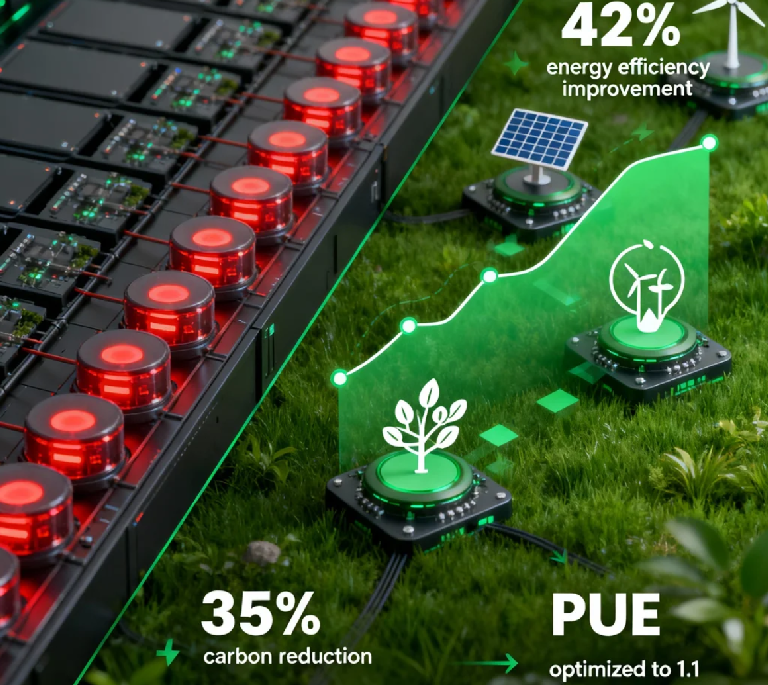
But change is happening. A video streaming platform implementing intelligent power management not only improved energy efficiency by 42%, but more surprisingly, reduced their network latency by 15%. This proves a groundbreaking perspective: green computing is not the enemy of performance, but an ally in optimizing it.
Redefining CDN Energy Efficiency
Traditional CDN energy management is like filling water with the tap running - even when you don't need that much water, you can't turn it off in time. Data from an e-commerce platform shows their edge nodes maintained 85% of peak power consumption during traffic troughs, while actual load during these periods was often less than 30%.
The core of intelligent power management lies in precisely matching energy usage with business demands. This is like an advanced automotive engine management system that adjusts fuel injection in real-time based on road conditions. A social media company deploying such a system saved energy equivalent to the annual electricity consumption of 2,000 households within six months.
Three Technical Pillars Building Green CDN
Achieving sustainable CDN architecture requires breakthroughs in three key technologies:
First is predictive scaling. By analyzing historical traffic patterns using machine learning algorithms, the system can forecast resource needs in advance. A news portal using this technology automatically warms up nodes 2 hours before major events and intelligently shuts down redundant resources during traffic troughs, achieving 38% energy reduction.
Second is dynamic frequency adjustment. Like smart thermostats adjusting air conditioning intensity based on room occupancy, CDN nodes can adjust processor frequency according to real-time load. Practice at a gaming company shows this technology can reduce single-node power consumption by 25% without affecting user experience.
Most importantly is renewable energy integration. By deploying solar and wind-powered edge nodes globally, a cloud service provider has achieved 45% clean energy usage in operations. Their goal is to increase this to 80% within three years.
Implementation Path: From Experimentation to Scale Deployment
Building sustainable CDN requires a systematic approach:
The first phase establishes energy efficiency benchmarks. A content provider deploying smart meters and monitoring systems precisely measured each node's Power Usage Effectiveness (PUE) for the first time. They were surprised to find some nodes had PUE as high as 1.8, meaning for every 1 watt consumed for computing, 0.8 watts were needed for cooling and power distribution.
The second phase involves workload optimization. By analyzing traffic patterns, they redistributed services to more energy-efficient nodes. A video platform discovered that by shifting nighttime traffic from traditional data centers to renewable energy-powered edge nodes, they not only reduced carbon footprint but also saved 30% in costs due to off-peak electricity rates.
The third phase is architectural refactoring. A tech giant designed a novel "sleep-wake" mechanism allowing edge nodes to enter ultra-low power states when idle and quickly restore when detecting traffic. This innovation helped them reduce annual energy consumption by 35% while maintaining service quality.
Real Benefits: Returns Beyond Energy Bills
Sustainable CDN architecture delivers benefits far beyond electricity savings:
A fintech company found that after adopting green CDN, their brand reputation improved by 28%, directly reflected in customer loyalty and market share growth.
More surprisingly is performance improvement. As intelligent power management reduces equipment heat density, node stability significantly improves. An e-commerce platform reported hardware failure rates decreased by 45% after implementing the new architecture, meaning more reliable service quality.
Addressing Challenges: Dual Transformation of Technology and Culture
Achieving sustainable CDN isn't without obstacles:
Technical debt is the most direct challenge. A traditional enterprise's CDN architecture had been running for ten years, making transformation extremely difficult. They completed the green transition over three years through gradual refactoring.
Cost perception needs breakthrough. Many still believe green computing means higher investment. An operator's practice proved the opposite: their green CDN project recouped investment through energy savings within 18 months.
Skills transformation is key. Traditional network engineers need to learn new energy management knowledge. A service provider successfully achieved knowledge transfer by establishing a dedicated green technology team.
Innovation Frontier: Next-Generation Green CDN Technology
Sustainable CDN development is accelerating:
Liquid cooling technology is being applied to high-density edge nodes, reducing PUE to an amazing 1.1 or below. An AI company deployed triple the computing resources in the same space using this technology.
AI-driven energy optimization is maturing. Systems can analyze thousands of variables in real-time, including weather, electricity prices, and traffic predictions, making optimal energy decisions.
Blockchain technology is used to build transparent carbon footprint tracking systems. Users can now precisely understand carbon emissions generated by each content request.
Begin Your Green Transformation
Now is the time to rethink your CDN architecture. Start with these questions:
Do you know your CDN's specific carbon footprint numbers?
Are there nodes running inefficiently?
Are you fully utilizing renewable energy?
Remember, the best technology decisions must consider not only performance and cost but also environmental impact. Sustainable CDN isn't an option but a responsibility digital enterprises must undertake.
When your business growth no longer comes at the cost of environmental burden, you truly grasp future-ready competitiveness. This green path is challenging, but every step creates a better digital world for the next generation.
